 “….we yet want another canoe, and as the Clatsops will not sell us one
The Journals of Lewis and Clark
As a freelance columnist I weigh in on many issues that are covered by the press. Sometimes the coverage itself merits comment, as evidenced by a local Indian story.
For me this story began six years ago when I was asked to participate in a potlatch – the traditional gifting celebration that anchors the indigenous culture of our region. This particular potlatch coincided with the Lewis & Clark bicentennial, and was hosted by descendents of the people who greeted the explorers here at the Pacific.
Why was a pale-skinned pup asked to stand beside Northwest Indian elders, overwhelmed with humility in front of 250 people? Because the Clatsop-Nehalem Confederated Tribes wanted a member of the local press to serve in the formal role of witness.
The historical context of that role humbles me. Conquest of this continent was often scouted by my kind — scribes who tell stories on paper. It can be argued that Lewis and Clark were journalists, dispatched to gather written intelligence for empire builders.
By contrast, indigenous people of the Northwest cleave to oral traditions. Though it surprised me at the time, I now understand why ten minutes into the potlatch I was asked to put away my pad and pen. My challenge was to watch and listen, with pure attention, then give an honest account from memory.
Since then I’ve written a number of columns in local newspapers about what I witnessed at that event. I’ve described how gifts were given in a ritual way, to join together people and tribes in a web of generosity.
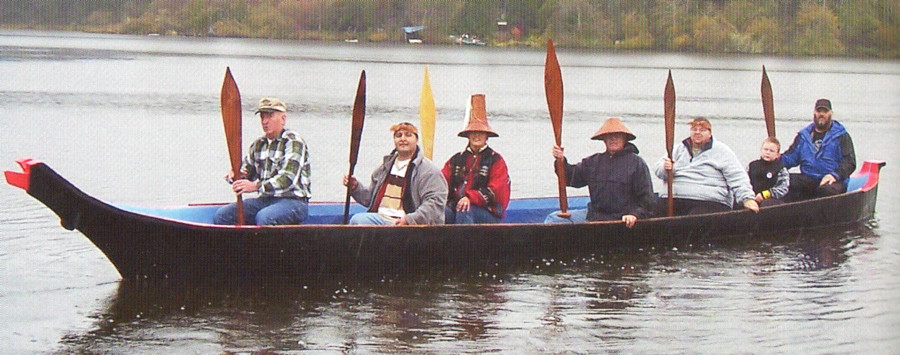
At the center of those gifts was an old-growth cedar, gifted by the Quinault Indian Nation. Many Clatsop-Nehalem people who were displaced from their homeland went to live with the Quinault, who welcomed them. The gift tree was carved into a 32-foot seaworthy canoe, with guidance from a master carver trained in traditional native canoe making. This was made possible in part through federal grant funding.
The ceremonial presentation of that tribal canoe — named Dragonfly — was a centerpiece of the potlatch. Everything about it was carefully thought out, including the timing to coincide with the bicentennial. For the Clatsop-Nehalem, their new canoe was reparation for one that was stolen from them by the Lewis and Clark expedition.
The vessel’s significance to the recovery of Indian heritage was newsworthy, especially in light of the timing. Yet despite sweeping press coverage of the bicentennial, the canoe was barely mentioned beyond my local columns. As often happens, truth was buried beneath a mainstream narrative. The cross-country adventures of famed white explorers, re-enacted by men in costume, brushed over the fact that those celebrities were also thieves.
So it goes, as it has for hundreds of years. The people who have lived here for millennia continue their work of cultural reclamation, undaunted by the gap between what’s written and what’s done. Like returning salmon, the Clatsop-Nehalem are determined to regenerate their relationship with their homeland.
This was clear during the past year. The tribes published a beautiful and informative book titled “The Journey of the Clatsop-Nehalem Canoe,” written by local artist Roberta Basch. Last July, Clatsop-Nehalem and Warm Springs families joined together to participate in a canoe gathering located in Swinomish, Washington. They paddled 407 miles and camped 22 nights in order to celebrate their culture with other native people (watch the documentary video).
Not long after that journey, the canoe story took a very strange turn. Members of the Clatsop-Nehalem Confederated Tribes were surprised by an article in the Daily Astorian (September 21, 2011). The press announced that the family of explorer William Clark was making a public gift of a new canoe to replace the one that was stolen by their ancestor’s expedition. Five days later a second article reported on this gifting.
Here’s the stunner: the Clark family gave it to the Chinook, a neighboring people who did not own the original canoe that was stolen. Moreover, news coverage advanced the claim that both the canoe and the story of its theft belonged to the Chinook. The press even referred to the Clatsop chief who suffered the theft as “Chinook” Chief Coboway.
Stories are a core part of human identity, as integral to the people of the Pacific Northwest as potlatches, cedar, salmon, and seagoing canoes. Understandably, a strong corrective action was requested by the Clatsop-Nehalem.
To date, that appeal has gone unanswered by the mainstream media. Instead, the Associated Press spread the fallacious story to news outlets around the country. The impact of this coverage has been conveyed to me in writing by tribal spokesman David Stowe, a 7th generation descendent of Clatsop Chief Coboway.
“It was shocking, surreal, and disturbing to me personally to see a member of my family, Chief Coboway, being referred to as a member of another tribe with no mention of the Clatsop tribe he belonged to,” writes Stowe. “The entire tribe is very unhappy with this effort to erase our tribal heritage, and is determined to put an end to this misinformation and get the true story published.”
Who among us would not be equally offended if our cultural heritage were displaced in this manner?
The situation grieves me, but not because I feel sorry for anybody. The more I learn about the Clatsop-Nehalem, the more assured I am of their resilience. The expropriated story of a stolen tribal canoe will not weaken their cultural revival.
What’s less certain is the future of a tribe we call the American press. Our integrity as witnesses is in need of repair, as evidenced by this and other stories. Can we reclaim our role as truth-tellers?
If so, part of our upstream journey involves a special canoe, gifted in a traditional way at a Clatsop-Nehalem potlatch.
— Note: This column also appears with an informative companion article in the March, 2012 issue of HIPFiSH (many thanks to local media hero Dinah Urell). Long live the alternative press!

“….we yet want another canoe, and as the Clatsops will not sell us one at a price which we can afford to give we will take one from them….”
the arrogance and the hypocrisy are astounding. not much has changed in the attitude of the Haves vs. the Have-Nots, from that time until now.
adding to previous post (3 minutes ago!)
shame on KMUN and the Daily Astorian for not correcting their error.
i wouldn’t expect more from worldwide media, but from our local news i would.
I remember speaking with writer Michael Burgess shortly after the Clatsop-Nehalem potlatch. He reaffirmed a core insight as I wrote about that event for the Seaside Signal (where I was a columnist at the time). Michael said the conflict between indigenous people and newcomers is rooted in the clash between a culture based on giving and a culture based on taking.
Thanks Watt!
What a sad commentary on the state of journalism throughout the mainstream media. It reminds me of the story of the Clatsop/Nehalem woman who put herself between a white settler and an Indian during a confrontation that was about to become a murder. She prevented an escalation that would have led to more tragedy, but she also received no recognition for her heroism. In the late 70s, a former CB resident wrote an article about it. Connie Anderson moved to Montana and when last I heard about her, she was teaching high school.
Jerome
Right on, Jerome. Surely most north coast residents want to hear these deep local stories. Yet some in the media are resistant to truth-telling, and that is also part of the story. It raises the question of motivation.
I’m thinking about this today, on the anniverary of the date that the theft of the Clatsop canoe was first noted in the journals of Lewis & Clark. It’s also St. Patrick’s Day.
The coincidence seems meaningful to me. Our media’s erasure of Clatsop-Nehalem history reminds me of the way textbooks have scrubbed over Irish history. A St. Patrick’s Day post at today’s BBQ links to a blog that tells how Irish peasants starved during the potato famine while growing other food for imperialist landlords (http://www.commondreams.org/view/2012/03/15-4). Textbooks usually omit that part of the story.
Many of us have heard the legend of how Saint Patrick drove the snakes out of Ireland. I’m not too keen on the tale, as some suggest it represents the subjugation of indigenous traditions by the Roman-British empire. But if we accept the legend purely as a tale of spiritual strength, we might expand on it. I can imagine the Green Crusader taking a break from his work to convert Irish natives, spiriting himself away for a wee vacation on the Oregon coast. That could explain our lack of venomous serpents here.
If that’s the case, though, he left us with plenty of forked tongues. History clearly shows us that truth-telling doesn’t follow the conquest of indigenous people. And history repeats itself, if we don’t pay attention.
I had a similar potlatch experience a few years ago when several parents, teachers and students from my son’s school in Seattle, AS#1 (now Pinehurst Elementary), went to Hydaburg, Alaska to give away a canoe we built for the Haida people. This tribe also has been through the ringer of white domination. The tribe was split between Canada and the U.S., and the village that we visited in Alaska was forcibly converted to Christianity and is still poor. Poor in money only! By far the best hosts I’ve ever experienced, and the bounty of the sea and land there is incredible. I will try to find the article I wrote about the trip for the school newsletter and post it on the Edge. A highlight was a seder in a church there!
Here’s a photo of the canoe, which took 3 years to build, and as far as I know, is still going strong. The graduating 8th graders are rowing with the master carver, Saaduuts, who directed the building of the canoe in Seattle. The canoe is steered to shore with the backs of the rowers facing the village, in a gesture of trust, all part of the ceremony of the gifting of the canoe to the people of Hydaburg.
I remember meeting Saaduuts when I was working for the Haystack Rock Awareness Program. It had been a very busy day at the rock and a very low tide at the end of the summer. The staff were getting tired and cranky. I was way out at one of the needles when I turned around to see the rest of the staff holding hands in a circle. Saaduuts had seen how fatigued the group was and brought them together to pray for the rock and the work being done there. I later got to speak with him and hear about his vision for educating people and protecting our environment. What a blessing to have this moment in time with him.