When I hear the name Hayao Miyazaki, I think of clouds. Like the kind we see in Cannon Beach on magical evenings after the sun has set, when gold lines our horizon and pink rims giant, puffy pillars.
I think of long grass, like on our sand dunes, bending gracefully before mounting winds. And I think of flying images from his films: robots, planes, pig pilots, cat busses, girls on broomsticks, skyscraper-tall gods walking through forests with birds circling their heads like gnats. I think of days long gone and too few when I would lie on hills, like his characters often do, and watch clouds become ships and elephants and alien armadas.
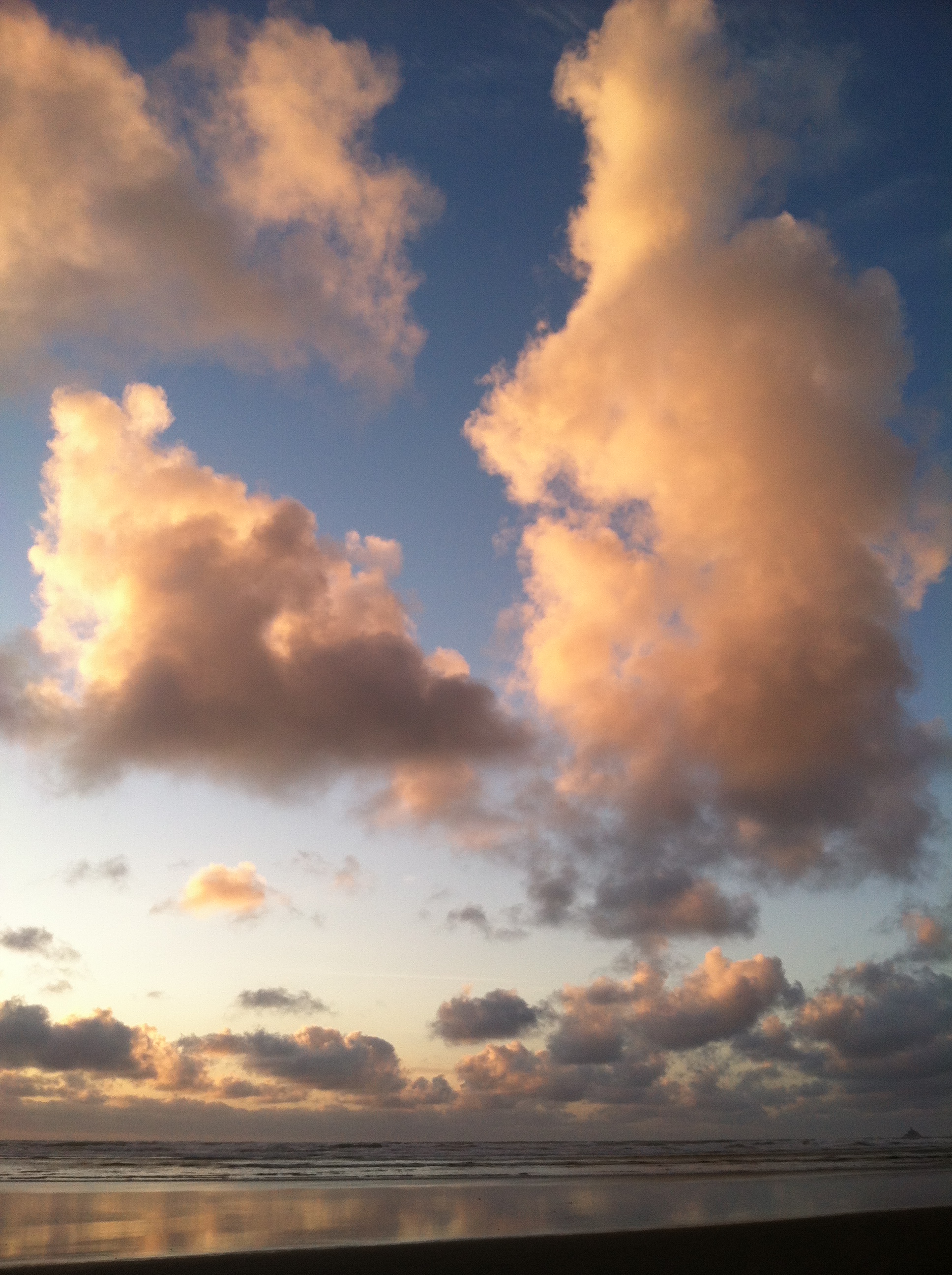
As much as any filmmaker I know, along with early Spielberg and Terrence Malick, Miyazaki revels in moments of quiet wonder. He’s not tied to the West’s non-stop narrative train where action must pile upon action; he slows story for nature. In a Miyazaki film, your soul can breathe. In those moments, it can even wander (a close cousin to wonder), pray, inhale secrets, exhale promises, or daydream a little.
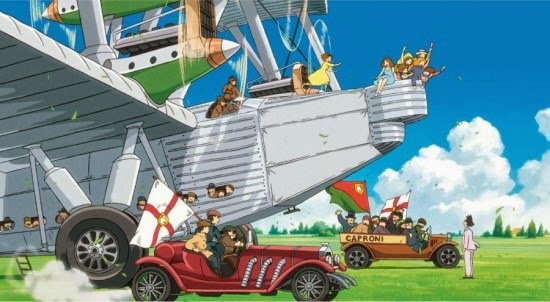
This isn’t to accuse him of being a nature poet only, for he is a masterful storyteller, compelling us to care for characters on journeys of change. And his chosen medium of animation provides visceral action that CGI films have yet to catch up to. I’m thinking of the scene where a railroad trestle hundreds of feet high crumbles under a hard-charging steam auto or this scene where a robot escapes a fiery pit of hell to rescue a princess (both from Castle in the Sky).
But across all of his films, it’s clouds, planes, and wind he loves most. And few capture them so languorously, and proclaim them so thematically central to one’s work, dreams and even love, as The Wind Rises, his most recent (and final) film.
He had every right to play the sentimental or nostalgic card this last time around. In the latter third of his own life, he could be forgiven for returning to the simple joys and broad strokes of childhood passions. Of piling them all into one film. Of leaving us with one final shout of cheer. And he does. But he gives us more than that. More than his other films, he embraces the paradox of living purposefully through suffering in The Wind Rises.
Upon first hearing the title, I imagined an exalted film. Is not rising wind key to flight? Is it not the ‘lift’ beneath the dreams of every aeronautical engineer and pilot? So I entered the theater expecting exhilarating flight that would recall the images and associated emotions of ascendency and resurrection. What I got was an adult meditation on the misuse of beauty, the loose grasp of love, and seeking true living in the face of approaching storms.
The words of the title first appear on screen as part of a poem by Paul Valery, where he writes (translated from French), ‘The wind is rising! We must try to live!’ Which immediately raised a question for me.
If ‘The wind is rising’ only means joy, exhilaration, triumph over gravity, flight and progress, then why this admonition? Why this bold exhortation if it cannot also mean the opposite: wind which sucks the life out of you, causes fear, or portends tragedy?
Then I thought of the storms we have here on the coast. Ones announced by rising winds. As southern winds increase, torrential rains and hurricane-like blasts sometimes follow. It’s a signal then: this wind.
To Miyazaki’s credit, the film is constructed around this paradox. Consider the breath-stealing sequence of the Great Kanto earthquake of 1923. Mercifully short, it puts other filmed ‘end-of-the-world’ sequences to shame as land heaves upward in rolling waves, lifting buildings like breadcrumbs shaken from a picnic blanket. But before this disaster, before the fires and the cries and the cracking destruction, there is silence. And in that silence is a groan, as the land in the distance gives way, and a wind (like a breath) of suffering rolls toward the characters. This moaning of the earth, this presage to disaster, is the wind rising.
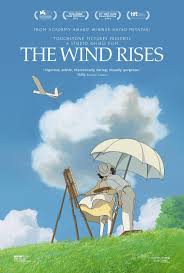
In another scene (the image used in most advertising posters), our hero falls in love with a girl painting on a hillside of puffy clouds. It’s a vision of loveliness to be sure. But because wind is present (he makes sure you notice by having it sweep away her umbrella), Miyazaki is warning that not all will be bliss.
Dreams. Planes. Love. They all soar on rising winds in Miyazaki’s final film. It is a sumptuous feast of color, design and restrained emotion. Out of it he crafts a bold message of hope, saying that as we follow dreams, fall in love, and do our life’s work, the wind is always rising. The storms of life — suffering and trial, tragedy and death — greet us. Still, Miyazaki’s heroic characters, colorful planes, and breathtaking skyscapes urge us to ‘try.’ We must do our best to truly live, he says, in facing sadness. To fly. To dream. To love. All these are to live.

Very thoughtful review GP
Many traditional storytellers wrestle with disruptive forces in our lives. Among indigenous cultures it is common to tell stories about beings called tricksters or transformers. These beings often manifest as certain animals and they are always getting into trouble. Coyote and Raven are familiar examples in North America. Brother Rabbit’s song is still sung in West Africa and the American South. Japanese people celebrate Tanuki, a species of wild canine that looks like a raccoon.
The north coast of Oregon may be one of the only places on earth where the trickster/transformer is called “South Wind.” I thought about this Rick while reading your SUPERB reflection. I don’t claim to know much about such beings, how their personalities differ from place to place or how they generally fit into the cosmos. Yet their stories do teach humans how to behave, or how not to behave, often by reverse example.
Miyasaki also teaches, and his stories often include realistic trickster/transformer characters who are both good and bad. He encourages us to have empathy for enemies while standing up for what is beautiful and right. May his art inspire us to carry that creative force forward.
I have not seen The Wind Rises, yet, but Miyasaki’s brilliance was captured so well in the earthquake clip you shared. The frame that punctuates it for me is when, after that massive disruption of human infrastructure, a loosened rock rolls to rest beside a flower that’s still intact.
I was struck by that moment, too, Watt and didn’t even notice the flower! I was just marvelling how such a giant (it starts with a shot from a high plane of the whole area) and destructive sequence could come to an end with the settling of a tiny pebble. I think about that walking our shores sometimes, how the massive energy of a world spanning ocean ends meekly at my feet in tapering foam. Thanks for your eyes. And words.
What I’ve enjoyed most about his previous films is their dreamlike, surreal quality. This last pic sounds more realistic and less fantastic, more reflective, melancholic and painful. I’m intrigued and yet not eager to see it. Have I been brainwashed by the American proclivity for escapist entertainment?
You’re right, sbonn, but this film isn’t painful. It’s surreal, dreamlike in spots, and hopeful. Some films are so artfully done that they take you to meaningful places. You can trust the storyteller not to abuse but to gently enlighten and uplift. I’m not sure Mr. Miyazaki would promise, like Mr. Disney does in Saving Mr. Banks, that everyone leaving his films will rejoice, but I think some word akin to that — more reflective, spiritual, and uplifting — would work. I’ve seen it twice and would go again in a second. Food for the soul, it offers.
What a beautifully written review Rick. I love the poetry in your writing, like
“as land heaves upward in rolling waves, lifting buildings like breadcrumbs shaken from a picnic blanket”.
I’m really looking forward to seeing this film (more so now because of your words).
Thank you.
Thank you, Jennifer. It’s your husband’s encouragement that empowered this exploration into whether a very personal response could attract or please any readers. I truly enjoy the dialogue and would love to hear about your favorite Miyazaki film!