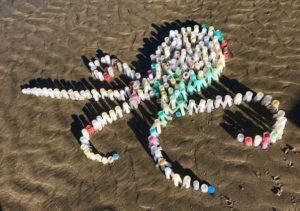
The upper left edge of the contiguous United States meets the Pacific Ocean at an ever-shifting demarcation known as the wrack line. Here, material that is variably ashore and afloat gets deposited through a process of weather, topography, bathymetry, lunar influences (tides) and ocean waves that are the energy messengers of events taking place beyond the horizon.
The coastline here (let’s say from the mouth of the Columbia River to the tip of Cape Blanco, that is, between the lower 48’s largest westward flowing river and westernmost point of land) includes everything from sheer rock cliffs to broad sandy beaches. The many miles of accessible shoreline are a gift of nature and of earlier Oregonians who fought to ensure that private ownership did not interfere with the human urge to be near the sea. That urge accounts for the continued vitality of many communities on the coast and may play a role in preserving the life of the oceans.
By now, most everyone knows that the material found on or near the wrack line regularly contains unnatural, man-made debris. Lots of it. The great pacific garbage patch — “driftage” from the 2011 Tohoku tsunami, “ghost nets” and other fishing gear — combine with literal rivers of plastic trash flowing down the Yangtze, Xi, Mekong and Ganges rivers (to name just a few) into the sea. Every 60 seconds a truckload of plastic enters the ocean. One would have to live in a cave to remain unaware that the world’s oceans and shorelines are choking on man-made, plastic debris.
Like some other people here, I pick the stuff up. There’s far too much to make a dent as an individual or feel a sense of accomplishment, though when participating in one of the large group shoreline cleanups, I’ve contributed to impressive totals hauled away for recycling (ideally, but far from certainly) or to landfills. Even considering the miles of remote shorelines where debris has piled up, it’s uncertain where vast amounts of it have gone. Plastics break down through solar (photo) degradation and mechanical abrasion into smaller and smaller pieces. Even after it becomes microscopic, it remains foreign, synthetic, non-biodegradable and therefore non-bioavailable. Through a process of adsorption it is also often toxic.
Photographs of sea-birds feeding their chicks with plastic debris, turtles with drinking straws stuck in their nostrils, whales with everything from plastic shopping bags to automobile parts lodged in their stomachs, all depict fatal cases of mistaken identity since animals cannot distinguish between what is edible and what’s inedible and harmful. More than 100 species of seabirds have been confirmed to eat plastic. The photos are disturbing, and hint at the vast scope of the damage being done. Some way needs to be found to stop the flow the plastics into the oceans and clean up what’s already there.
On the wrack line, scanning the shore for plastic debris with a shoulder bag and gloves, the mind wanders far. It might be meditative except my thoughts don’t always trend expansively. Alarm, disgust, bewilderment… misanthropy intrudes despite the beautiful surroundings of sea, shore and sky. To remain positive, and sane, while navigating the scree of bottle-caps, cigarette butts, plastic doggy poop bags (with contents), ‘chew’ tobacco containers, and so on, I try to imagine what more can be done. Consuming less, taking care to recycle and re-use and, when necessary, discard responsibly, are essential practices that are embraced by many in my community. But it’s evident that the majority of items found are not local in origin and a solution requires reaching the wider public with a persuasive message.
Since I can’t pick up everything I encounter, I sometimes focus on a particular type of debris or only gather the plastic pieces that may later find a place in a composition. Some items I’ve wondered for years what they were. Others are still mysteries. Particularly exasperating are items that enter the environment not by mistake or carelessness, but by design. The images here were created with just such a type of debris. The pieces are shotgun shell wads that fly out into the environment, often entering the ocean and, eventually, the wrack line, every time a shotgun is fired. They can’t reasonably be retrieved by the hunter. I gathered them on the Nehalem Bay sand spit over a month of winter storms and king tides. They represent a small portion of hundreds I have gathered. Unlike most other plastic debris in the marine environment, these automatically pollute… by design.
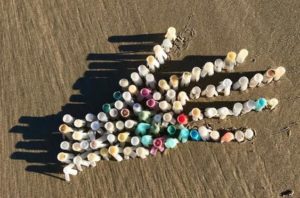

A very compelling piece. I have recently discovered that there are shot gun wads that are biodegradable and designed by marine scientists.
Just a couple of days ago, I wrote our local state Rep, Tiffiny Mitchell and asked if she could champion a bill to ban the old plastic models. It’s a very specific request so perhaps that will make it a simple one.
John Morris, thank you for writing this. Perhaps we can get some legislative help!