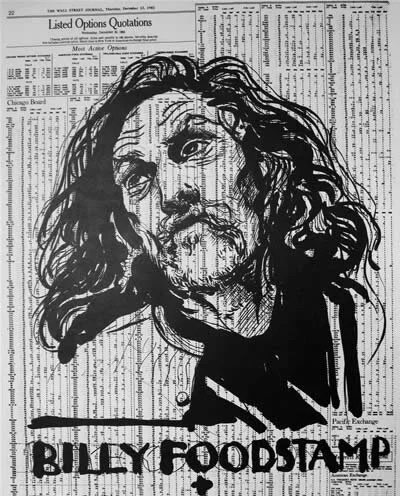
THE GHOST OF AN OLD FRIEND recently visited our kitchen as the family was fixing breakfast. It had been a spell since my mind had hugged this being who’s remembered by various names in Portland and Cannon Beach.
Billy Foodstamp. Washboard Billy. The Beloved Reverend Billy Lloyd Hults.
When our kids were tykes they called him “Wildman Billy.” It was a gracious title, because they were wilder in many ways. Billy generally adhered to domestic decorum, in fact he helped us train up our wee hillbillies by admonishing them not to stand on the dinner table.
Still, they saw him as a kindred free spirit.
“Wildman” was like “hippie,” I reckon. He wasn’t much of a flower-child by the time we crossed paths, but I could imagine he’d once been close enough. My elder by 19 years, Billy saw the 60s and 70s from the vantage of a young streetwise adult. During those decades, while he was jugbanding around the Northwest, I was toddling and adolescing amid the hills of Appalachia.
I met Billy at Jupiter’s Books in the early 90s, soon after I married into the Oregon coast. Billy had left Portland’s metropolitan quirks to stir up the Haystack publicans. An artist of humble means could still eke out a living here in those days.
Fellow activists, we’d compare notes when Jennifer and I came to visit the family. He supported efforts to protect old growth forests and undeveloped shores. At the time I was trying to curb urban sprawl, working to shift transportation spending toward maintenance and repairs, promoting farm-direct markets for meat and produce.
Though Billy was a city critter, we shared a love of nature that had drawn many folks back to the land. To me he was a curator of America’s counterculture, a wits-keeper who held on to founding visions of bohemian exuberance and beat reciprocity. He was the first person to tell me about the Diggers of San Francisco, for example, a mutual aid group that distributed free food and engaged in street theater during the late 60s.
And here’s a key thing about Billy’s hippie wildness – he wanted everyone to have access to life’s party. He welcomed both the destitute and the suits to friendly fests he helped organize, safe spaces where all could enjoy the creative commons.
This dream of inclusive hospitality has slipped away from our country. Indeed, it’s been pushed aside by a members-only mindset that’s all too easily swayed by scapegoating and extreme partisan feuds.
Yet the molecules of Billy’s world still surround us.
OUR KITCHEN REUNION BEGAN with a feature article in The Oregonian. It was a fitting way for Billy to knock on my perception, given his passion for the written word.
Journalist Douglas Perry wove a compelling story about the Reverend’s pivotal role in what became known as Portland’s “Mayor’s Ball,” first held in 1985. The inaugural bash was organized to pay off the campaign debt of Billy’s tavern-owning friend, Bud Clark, who defied long odds to win one of the most colorfully insurgent elections in American history.
Held at Portland’s Memorial Coliseum, the event is recorded in the Guiness Book of World Records for hosting the most bands under one roof at a single venue. During an era when large musical events were dominated by commercial supergroups, Billy and his cohorts did something wonderfully crunchy and diverse. They invited a plethora of artists to play, saluting the spirit of e pluribus unum, from many one.
Billy was proud of the fact that his massive fest was not formally policed and no one was hurt. Many people collaborated on that peaceful move beyond the political establishment. Yet Perry credits Billy with spearheading the event that whetted Portland’s appetite for benevolent weirdness.
“The city’s know-it-alls might have expected a debacle, but everyday Portlanders were intrigued by the ball’s ambitious scope – and heartened by its attempt to appeal to one and all: Republican and Democrat, businessman and minimum-wage worker, freak and geek.”
Two morsels jumped out at me from the article.
1) Billy envisioned his jumbo-romp as a “people’s party.” The idea connects with something deeper than a political figure or governmental office. It was an affirmation of side-by-side solidarity, definitely not a nod to vertical authority.
2) Billy’s maxim nails the ground rules for human co-existence. “Everybody Eats, Nobody Hits, Then We Talk.”
These bites of insight point to a prime directive for America’s well-being. We need to feed community. Now’s a crucial time for us to embrace that priority here on the wild frontier.
WHAT WE CALL “COUNTERCULTURE” can rejuvenate lifeways that nourish local resourcefulness and self-determination. I’ve witnessed this kind of teamwork at formative times in my life. It was manifest in 1981, for example, when two high-school-graduating classmates and I drove west to visit The Farm in middle Tennessee.
We’d already met some residents of the large hippie commune, at a fiddler’s jamboree the summer before. It was inspiring to witness those tie-dyed folksters skip up on stage to accept most of the awards, including the grand prize for square dancing.
While visiting the community my buddies and I helped a family build a roof connecting their home with a bus that they’d driven there ten years prior from San Francisco. Like the Diggers, inhabitants of The Farm were motivated by strong collective values. Among other achievements, they revitalized the art of midwifery and grew much of their own food.
Billy and I swapped stories like this every time I came to Oregon. We didn’t argue about isms or fuss over economic philosophies. Ideas for activating goodness weren’t part of any partisan training manual, more like stanzas in a collaborative free-verse poem.
Sometimes he’d publish stuff I sent him in the Upper Left Edge. For many years I figured the paper was named as a wink to politics or geography. Yet shortly before he died Billy shared the masthead’s real meaning.
“It’s the place on the page where we start writing,” he said.
SO IT HAPPENED that Billy rode into our kitchen on the printed word. The encounter aligned with plans for the 250th Birthday of the U.S.A., marked by a written document signed by people who, like Billy, believed in everyone’s inalienable right to life, liberty, and the pursuit of happiness.
It also synced up with an emergent mission that’s written on my heart – to support fellowship around home-cooking. Gatherings with shared food are a deep-rooted part of my heritage, as is true for most everyone.
In recent years we’ve worked to revive that tradition with community potlucks in Cannon Beach. Once an active part of our local culture, these get-togethers never ended. They waned however as our little coastal village became more focused on transient commerce than year-round inhabitants.
Visitors to the coast benefit equally from a vibrant residential quality of life. Billy contributed to this local mutualism – by running Jupiter’s Books, publishing the Upper Left Edge, and by co-founding a not-for-profit group called the Tolovana Arts Colony. He’s one of many heroes who enlivened workaday routines with creative social exchange, integrating economy with ecology.
Some of us have carried this effort forward in different ways. For over a decade conservationists hosted an annual potluck to celebrate the return of native salmon, for example. Participants brought dishes from our kitchens to share, a tradition of mutual hospitality that’s been practiced for as long as anyone remembers.
Two years ago the Tolovana Arts Colony began hosting potlucks to mark the seasonal turns. In keeping with Billy’s maxim people shared home-cooking, strengthened relationships, and talked about important topics.
Each potluck featured an engaging theme and guest presentation. To celebrate the spring equinox of 2026 we organized a kitchen-curated feed that coincided with World Water Day. Speakers inspired and educated us about the need for shared stewardship of our coastal watersheds.
UNFORTUNATELY, SOON AFTER THE EVENT, government officials informed us that open community potlucks are illegal in our state. Most folks find this hard to believe, when I tell them. Yet the political establishment decided at some point that Oregon should be the strictest state in America when it comes to regulating potlucks.
Enforcement is selective, so many Oregonians have yet to experience backlash from the potluck police. Yet if what’s happening on the coast is any indication, get ready. Officials say communities here must follow the letter of Oregon’s law. In Cannon Beach, citizens have been told that our tradition of community potlucks must end. Long a core part of our community, Oregon considers these events to be Class C misdemeanors (punishable by fines of up to $1,200 and/or 30 days in jail).
Oregon could and should adopt more hospitable potluck rules similar to other states. My favorite is Minnesota, the land of 10,000 hotdishes. Lawmakers there show pride in neighborly reciprocity by exempting potlucks from regs that govern other food-related events.
It’s encouraging to hear hints that a “Potluck Bill” to change Oregon’s rules might be included in next year’s legislative session. I’d love to see our state follow Minnesota’s lead on this issue. Yet why wait, when boosting fellowship would be a healthy counter to today’s onslaught of disturbing and hate-filled news?
Oregon would be even more beautifully weird if state lawmakers and the governor officially relaxed administrative rules after hosting a special legislative potluck this summer. They could encourage togetherness by example, tee-up other practical reforms to help free folks from the overreach of top-down authority.
Generations have fed community with these homegrown fests, nourishing the common good in body and spirit. I can hear the reverend’s washboard echoing down the line, digging the next wild round to activate our union.

Had anyone been arrested and charged. And gone to court. I feel the judge would throw it out.
I’d like to believe it would never get to that point, where someone would be penalized with a fine and/or jail time for hosting an open community potluck. We won’t be faced with that possibility if our leaders adopt rules used in other states, like Minnesota.
Apparently there was a comment made during a recent council meeting / coffee gathering about “divisiveness.” The implication being, why are people disagreeing with us and why are they daring to stand up and speak about it?
I hear patriotic revolutionary theme music during this, the 250th anniversary of the people in America daring to ask for the right to make the rules that govern them (or if you would prefer, play music here from Les Miserables).
It feels like our government leaders in our village do not want their citizens to make the decisions about their governance. A potluck, God forbid, brings the citizens together in the only way that we can find to share our feelings, not formally – yet – but as neighbors and friends with a common interest. To that, how about bringing our village back to its Comprehensive Plan, which has been pretty much forgotten in the past few years.
That’s the only possible answer as to why they are upset with someone having a potluck to bring the citizens together to talk to each other. We can’t talk about it in the council meetings … sadly, the public comments leading off the agenda rarely get any sincere reaction or respect. Instead we hear “loud and angry.”
From Broadway to baseball: there was a major league manager who was asked the secret of his success. He said he kept the players who didn’t like him away from the players who did not. Control the environment.
To the barricades!
I imagine most members of city and county governments here on the coast support open community potlucks. It would help if they spoke up about this issue.
“ They could encourage togetherness by example, tee-up other practical reforms to help free folks from the overreach of top-down authority.“
This is exactly why potlucks are illegal in Oregon.
Government doesn’t want people to talk, share ideas, find commonalities and to talk with each other.
Think Covid1984.
Think Mainstream Media.
Think teams red and blue.
The government wants people distracted and divided so government can stay in control making profits from idiotic wars and restrictive policies.
Profits, power,, and control of people and resources is what keeps government in power and people in need.
Think about it and please do the research folks.
I can see how one comes to that conclusion, given all the frustration that accompanies disempowerment.
Here’s a truth that gives me hope and helps to fortify my activism. Many other states have passed legislation that allows folks to share homecooked food at free public gatherings. My conversations with Oregonians have made it clear to me that most people don’t even know these events are illegal. Once enough folks are aware, I believe Oregon leaders will change this law.
That’s just one step in our journey back to community, of course. Yet we make the path by walking.